

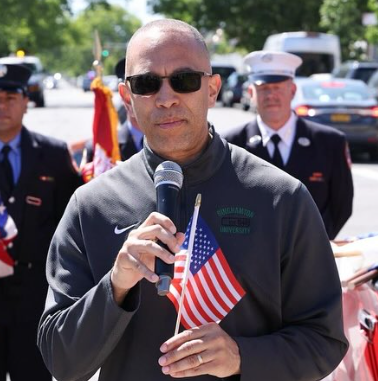
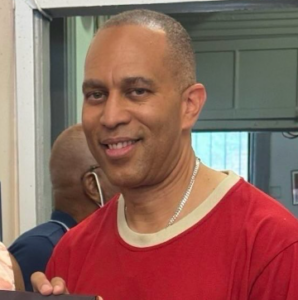
Hakeem Sekou Jeffries is a prominent American politician who has gained national attention as House Minority Leader
He made history in November 2022 when he became the first African‑American to lead a party caucus in either chamber of the U.S. Congress.
He was born on August 4, 1970 in Brooklyn, New York, and has deep roots in a multi‑generational African‑American family.
Throughout his life, Jeffries has identified proudly with the racial and cultural heritage of Black Americans raised in a historically Black neighborhood.
This article explores his ethnic background, his racial identity and how those aspects have shaped his life, leadership and public image.
Also Read: Dwight Howard’s Words of Caution for Cooper Flagg Go Viral
Table of Contents
Hakeem Jeffries’ Ethnic & Racial Background
Family Origins
Hakeem Jeffries is the eldest of two sons born to Laneda (née Gomes) Jeffries, a social worker, and Marland Jeffries, a substance‑abuse counselor.
They raised Hakeem and his younger brother, Hasan Kwame Jeffries, in Crown Heights, Brooklyn, a historically Black neighborhood.1
Jeffries’s family heritage traces back to African‑American ancestors who migrated to New York, likely during the Great Migration, carrying the legacy of resilience, community and civil rights activism.
According to genealogical research cited online, his great‑grandparents were from Virginia and Jeffries may carry ties to that region. One source estimated about 3/8ths of his heritage from Virginia roots.2
He is the nephew of Leonard Jeffries, a former political science professor known for his controversial views. His brother Hasan Kwame Jeffries is a respected historian and writer.3
Racial Identity
Jeffries has consistently identified as African American, part of the broader Black diaspora in the United States.
He is a lifelong member of Cornerstone Baptist Church, a historically Black congregation in Brooklyn affiliated with the National Baptist Convention. His faith community heavily influenced his social identity and public service values.4
He was the first African‑American to lead a major party in Congress. That milestone has shaped his national identity as a Black political leader.
Critics and observers have noted the symbolic importance of his leadership for Black Americans, especially in political institutions that have long lacked racial diversity.5
What have Republicans been up to this year?
Gut Medicaid ✅
Take food from children ✅
Reward billionaire donors ✅
Privatize Social Security ✅
Fire Veterans ✅
Mask ICE identities ✅
Try to rig the midterms ✅
Release the Epstein files ❌— Hakeem Jeffries (@RepJeffries) July 31, 2025
Personal Values Rooted in Identity
Jeffries grew up in a household and neighborhood shaped by civil rights heritage, Black church tradition and community activism.
His early experiences serving as a white‑gloved usher in church taught him to count, engage and serve. That foundation guided his commitment to justice, equity and public service.
He pursued higher education at Binghamton University, where he joined Kappa Alpha Psi, a historically Black fraternity.
As a chapter leader, he extended his network and leadership skills, reinforcing his cultural identity and community ties.6
His stance on police brutality, criminal justice and legislation like banning choke holds reflects the values shaped by his identity and upbringing in the Black community.
Also Read: Casey Mears Reveals the Harsh Reality of NASCAR Politics and Birthday Wish
Hakeem Jeffries’ District Demographics & Representation
Below is a stats table showing key demographic data for New York’s 8th congressional district, which Jeffries has represented since 2013.
These statistics help illustrate the context of his constituency and its diversity.

Stats Table: NY‑8 District Demographics (2023)
| Demographic Group | Percentage (%) |
|---|---|
| African‑American / Black | 42.2 |
| White | 27.4 |
| Hispanic / Latino | 16.2 |
| Asian | 8.8 |
| Two or more races | 4.3 |
| Other | 1.1 |
| Urban | 99.99 |
| Rural | 0.01 |
| Median Household Income | $59 764 |
| Cook PVI | D+24 |
Jeffries’s district is heavily urban and majority‑Black, largely covering neighborhoods such as Bedford‑Stuyvesant, Brownsville, East Flatbush, and parts of Flatlands and Coney Island.
His identity aligns closely with the community he represents.
Hakeem Jeffries’ Faith and the Black Church Tradition
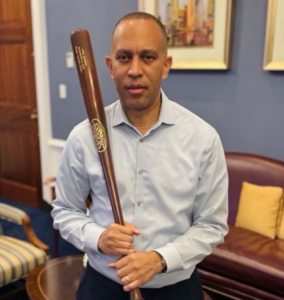
Jeffries’s leadership is deeply influenced by his Black Baptist upbringing.
He regularly attends Cornerstone Baptist Church, where principles of the social gospel taught him early lessons about service, justice, and community.
His political peers, including Nancy Pelosi, have remarked on his sincerity and how his faith, rooted in the Black church tradition, guides his public service ethos.
Fraternity and Community Engagement
Membership in Kappa Alpha Psi and leadership in his chapter at Binghamton University gave Jeffries a platform to deepen his commitment to Black uplift, cross‑cultural engagement and organizational skills.
Advocacy Rooted in Experience
When Eric Garner died in 2014 after a police choke hold was applied, Jeffries took legislative action to ban such use of force nationally.
His identity and experiences within the Black community shaped his urgency and authenticity in pushing for criminal justice reform.
He also championed the First Step Act, addressing sentencing disparities and recidivism. That effort reached across party lines and reflected his values of redemption and rehabilitation.7
FAQ’s About Hakeem Jeffries
Q1: What is Hakeem Jeffries’s racial identity?
A1: Jeffries identifies as African American and belongs to the Black, particularly African‑American, community. He is deeply rooted in Black cultural and religious heritage.
Q2: Does Jeffries have mixed or non‑Black ancestry?
A2: Public records emphasize his African‑American heritage. Some genealogical sources suggest a portion of his family originates from Virginia, but he has not publicly identified any mixed‑race ancestry beyond his Black identity.
Q3: Who are his immediate family members and how did they shape his identity?
A3: His parents, Laneda and Marland Jeffries, worked in social and mental health services. They raised Hakeem and his brother Hasan in Crown Heights. His upbringing in a socially conscious, faith‑based environment shaped his values.
Q4: Did Jeffries ever practice a religion other than Christianity?
A4: There is one instance during a political debate where Jeffries said, “my opponent is a practicing Muslim, and I grew up in the Cornerstone Baptist Church.” Some suggest that comment caused confusion, but Jeffries has always identified as Baptist and connected to Black Baptist traditions.8
Q5: How does his district reflect his racial identity?
A5: Jeffries represents a district where over 40% of residents identify as Black or African‑American. His identity aligns closely with the majority of his constituents, strengthening his representation.9
View this post on Instagram
Conclusion
Hakeem Jeffries’s ethnic background is firmly rooted in African‑American heritage.
Raised in Crown Heights, steeped in Black church tradition and connected to a community shaped by civil rights activism, he embodies a lived experience deeply aligned with his identity.
His upbringing and personal history inform his leadership style, legislative priorities and authentic connection with constituents in a majority‑Black district.
As the first African‑American to lead a major party in Congress, Jeffries not only represents a historic breakthrough but also a continuity of struggle, hope and service that resonates across generations.
His racial identity is not incidental—it is central to who he is, what he stands for and how he leads.
Also Read: Who Are Hakeem Jeffries Parents: Marland And Laneda? Nationality, Bio, Career And More