

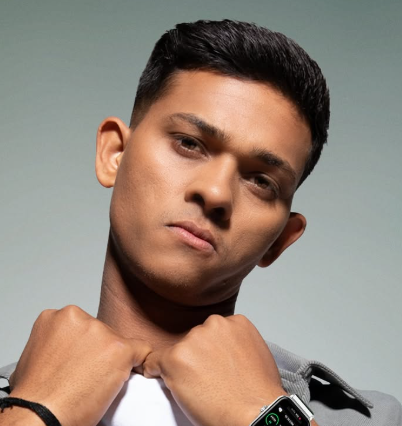
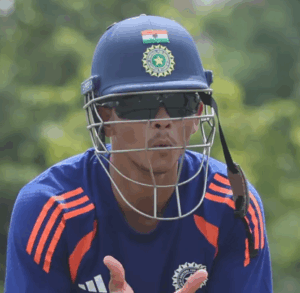
Yashasvi Jaiswal has become one of the most talked-about names in Indian cricket after reports emerged that he is learning wicketkeeping ahead of the 2026-27 domestic season
Known for his aggressive batting and ability to score big runs, the young Indian opener is now exploring a role that could add a new dimension to his cricketing career.
The development has attracted attention because wicketkeeping has not been a regular part of Jaiswal’s professional cricket identity.
For now, Jaiswal’s wicketkeeping practice should be understood as a reported experiment rather than a confirmed change in his official role.
There has been no established indication that he is giving up his position as an opener.
To understand why this development matters, it is important to look at Jaiswal’s early life, rise through domestic cricket, international achievements and the possible reasons behind his decision to learn a new skill.
Also Read: Eagles Star Lane Johnson Bio: NFL Career and Achievements
Table of Contents
Who Is Yashasvi Jaiswal?
Yashasvi Jaiswal is an Indian international cricketer who plays as a left-handed opening batter.1
He represents India in international cricket and Mumbai in domestic cricket. He has also played for the Rajasthan Royals in the Indian Premier League.
Born on December 28, 2001, in Suriyawan in Uttar Pradesh’s Bhadohi district, Jaiswal developed an interest in cricket at a young age. His journey from a small town to the international stage is one of the most widely discussed stories in modern Indian cricket.
Jaiswal first attracted major attention through his performances in age-group cricket. His ability to score heavily at the Under-19 level helped him earn opportunities in domestic cricket.
He later became a prominent name in the IPL and eventually made his international debut. His batting is known for its combination of attacking strokes, patience and confidence.
As an opener, he often faces the new ball and must deal with fast bowlers while the field is spread across different positions.
His ability to turn promising starts into big scores has been a major strength. Jaiswal has also shown that he can adapt to different formats.
Test cricket demands concentration and the ability to build an innings over long periods. T20 cricket requires quick scoring and smart shot selection.
His performances across formats have helped him become an important part of India’s batting plans. His wicketkeeping experiment has now added another chapter to his career.
Although batting remains his established role, learning wicketkeeping could help him understand the game from a different perspective and potentially give his team another option.
The game is changing rapidly, and so is the way we play it. Fast and fearless. I want my engine to have that same energy. That’s why I choose SERVO HyperSeries Lubricants. It’s advanced technology delivers powerful performance whenever I need it.
SERVO HyperSeries. Get Hyper.
@sahneyas
— Yashasvi Jaiswal (@ybj_19) July 9, 2026
Early Childhood
Yashasvi Jaiswal’s childhood played an important role in shaping his determination to become a professional cricketer.
He grew up in Suriyawan in Uttar Pradesh. As a young boy, he dreamed of playing cricket at the highest level.
However, reaching that goal required him to leave familiar surroundings and find opportunities in a city where competition for cricket places was intense. Jaiswal moved to Mumbai at around the age of ten to pursue his cricketing ambitions.
The move was a major step for someone so young. Mumbai had a strong cricket culture but making a name for himself in the city was never going to be easy.
Reports about his early life describe the financial difficulties he experienced while trying to establish himself. He stayed in challenging conditions and struggled to meet his basic needs.
At one stage, he lived in a tent at Azad Maidan, a well-known ground in Mumbai where many young cricketers practise.
He also reportedly helped food vendors sell pani puri to earn some money. These experiences made his journey more difficult than that of many young players who have access to established cricket academies and financial support.
Despite these challenges, Jaiswal continued to practise and play whenever he had an opportunity. Cricket became the centre of his daily life.
He understood that talent alone would not be enough and that he needed discipline and consistent performance to move forward. His fortunes began to change when cricket coach Jwala Singh noticed his potential.
Singh helped guide his development and became an important mentor in his journey. With better training and support, Jaiswal was able to focus more closely on improving his game.
His progress demonstrated the importance of both individual determination and the guidance of experienced people. Without consistent coaching and opportunities to compete, it can be difficult for young players to move from local cricket to professional teams.
Jaiswal’s early experiences also help explain why his career attracts so much attention. His rise was not simply about scoring runs.
It was also about overcoming difficult circumstances and remaining committed to a goal for years.
Stats Table
| Category | Details |
|---|---|
| Full name | Yashasvi Bhupendra Kumar Jaiswal |
| Date of birth | December 28, 2001 |
| Birthplace | Suriyawan, Bhadohi, Uttar Pradesh, India |
| Batting style | Left-handed |
| Bowling style | Leg-break |
| Primary role | Opening batter |
| Domestic team | Mumbai |
| IPL team | Rajasthan Royals |
| Test debut | July 2023 |
| T20I debut | August 2023 |
| ODI debut | 2025 |
| Test highest score listed by NDTV Sports | 214 not out |
| ODI highest score listed by NDTV Sports | 116 not out |
| T20I highest score listed by NDTV Sports | 100 |
| First-class highest score listed by NDTV Sports | 265 |
| IPL highest score listed by NDTV Sports | 124 |
Yashasvi Jaiswal’s Cricket Training Journey
Jaiswal’s development was closely connected to his cricket training. After moving to Mumbai, he worked to improve his batting technique, fitness and understanding of the game.2
Mumbai has a long history of producing successful cricketers. Its competitive domestic structure gives talented players opportunities to progress through school, club and age-group cricket.
However, the level of competition also means that players must perform consistently to stand out. Jaiswal’s early performances helped him gain recognition.
His progress through junior cricket brought him into the national conversation, particularly when he began producing big scores against strong opposition. One of his most notable early achievements came in a school-level Giles Shield match in 2015.
He reportedly scored 319 not out and took 13 wickets in the match. The performance highlighted his ability to contribute in more than one area of the game, although batting would later become his primary professional role.
Jaiswal’s success at the junior level continued when he represented India at the Under-19 level. He became a key batter for India’s Under-19 team and delivered strong performances at the 2020 ICC Under-19 Cricket World Cup.
His achievements at that tournament helped increase his visibility among selectors and IPL franchises. He was named Player of the Tournament after finishing as the leading run-scorer, strengthening his reputation as one of India’s most promising young batters.
Yashasvi Jaiswal’s Professional Cricket Career
Rise Through Domestic Cricket
Jaiswal’s domestic performances provided the foundation for his professional career. Playing for Mumbai exposed him to a demanding cricket environment where young players must compete with established names.
His ability to score consistently helped him earn attention beyond age-group cricket. He showed that he could build long innings in longer formats while also playing attacking cricket when the situation required it.
Domestic cricket is especially important for players who want to establish themselves in the Indian team. It allows selectors to assess a player’s technique, temperament and consistency over several matches.
Jaiswal used these opportunities to demonstrate that he could handle a higher level of competition. His performances also made him an attractive prospect for the IPL, where franchises look for young players who can contribute immediately and improve over time.
IPL Career With Rajasthan Royals
Jaiswal became part of the Rajasthan Royals setup and gradually developed into one of the team’s important batters. The IPL gave him a platform to face international bowlers and play in front of large audiences.
His breakthrough season came in 2023, when he scored heavily at the top of the order. He produced a memorable century against the Mumbai Indians and recorded one of the fastest half-centuries in IPL history at the time.
These performances demonstrated that he could combine attacking intent with strong shot-making. He was not limited to scoring quickly against particular types of bowlers.
Instead, he showed an ability to use different scoring areas and adapt his approach to the match situation. The IPL also helped him gain experience in high-pressure situations.
Close finishes, changing pitch conditions and tactical bowling plans all challenged him to make decisions quickly. His performances for Rajasthan Royals played an important role in strengthening his case for international selection.
International Debut and Test Success
Jaiswal made his Test debut for India against the West Indies in July 2023. He made an immediate impression by scoring 171 runs in his first Test innings.
The performance was an important milestone in his career and showed that he could handle the demands of international cricket. His success continued during India’s home Test series against England in 2024.
Jaiswal scored two double-centuries during the series and finished with 712 runs. His performances were among the major highlights of the contest.
These innings showed his ability to maintain concentration over long periods while still putting pressure on the opposition. His aggressive approach allowed him to score quickly without abandoning the discipline needed in Test cricket.
Jaiswal also made his T20 international debut in 2023. He continued to develop his game in the shortest format and became part of India’s wider plans for the future.
He made his ODI debut in 2025. His international career has therefore expanded across formats, although opportunities and competition for opening positions can vary between Tests, ODIs and T20Is.
Why Is Yashasvi Jaiswal Learning Wicketkeeping?
The main reason behind the discussion is the possibility that wicketkeeping could give Jaiswal another skill to offer his team.
According to reports published in October 2026, Mumbai captain Siddhesh Lad said Jaiswal had been practising wicketkeeping.
The reports described the skill as an addition to his existing batting role rather than a confirmed switch to a specialist wicketkeeper. There are several possible reasons a batter might want to learn wicketkeeping.
1. To Expand His Selection Options
Competition for places in India’s limited-overs teams is intense. Opening positions are particularly competitive because several established and emerging players are available.
A batter who can also keep wickets may offer a team more flexibility. Depending on the team’s requirements, a player who can perform two roles can help create additional options when selectors finalise a squad.
However, learning the skill does not automatically guarantee selection. A player must be able to keep wickets to a high standard while continuing to perform consistently with the bat.
2. To Add Value to Mumbai
Domestic teams often benefit from players who can contribute in more than one way. If Jaiswal develops reliable wicketkeeping skills, Mumbai could potentially consider him for different team combinations in the future.
That possibility should not be confused with a confirmed plan. Reports indicate that he is practising the role, but the extent to which he will use it in competitive matches remains uncertain.
3. To Develop a More Versatile Game
Wicketkeeping requires concentration, quick reactions, footwork and strong hand-eye coordination. Practising these skills could help Jaiswal develop a better understanding of field placements, bowling angles and the rhythm of an innings.
The role also demands considerable physical effort. A wicketkeeper must remain alert throughout long periods and respond quickly to edges, spin and changes in bounce.
For a batter, learning wicketkeeping is therefore a substantial commitment. It involves more than putting on gloves during a practice session.
4. To Explore a Different Career Option
Cricket careers can change because of competition, team balance and the needs of selectors. Players sometimes learn additional skills to keep more opportunities open.
Jaiswal’s wicketkeeping practice could be part of that broader approach. Still, there is no need to assume that he is abandoning batting or that the move has been made specifically to solve a selection problem.
Unless Jaiswal or his team clearly confirms the reason, the motivation should be treated as a possibility rather than a fact.
Also Read: Cal Ritchie Bio: What to Know About the Young NHL Star
What Has Been Reported About the Wicketkeeping Move?
The development became public in early October 2026, when reports noted that Jaiswal had been practising wicketkeeping ahead of Mumbai’s Ranji Trophy opener against Chandigarh.3
Mumbai captain Siddhesh Lad reportedly confirmed that Jaiswal was working on the skill. His comments generated further discussion about whether the batter might eventually aim to keep wickets for Mumbai or India.
The news also drew attention because Jaiswal had not established himself as a regular wicketkeeper in age-group or senior cricket. His reputation has primarily been built on his batting and his earlier experience with leg-spin has not made him a conventional all-rounder either.
Former India opener Wasim Jaffer questioned the decision and suggested that Jaiswal should concentrate on his batting. His view reflects a practical concern: wicketkeeping is a specialised role that takes time and regular match experience to master.
A player must judge the ball’s movement, maintain the correct position and react instantly to edges or deliveries that change direction. Keeping against spin adds further demands because the ball can turn sharply or bounce unpredictably.
At the same time, trying a new skill in training does not necessarily mean a player will use it in matches. Jaiswal could continue practising wicketkeeping without becoming his team’s first-choice keeper.
The most important point is that the experiment has attracted attention, but its long-term outcome remains unknown.

Could Wicketkeeping Help Jaiswal Return to India’s White-Ball Plans?
This is one of the most discussed questions surrounding the development. Jaiswal has already shown his quality in Test cricket.
However, selection in limited-overs formats depends on several factors, including current form, team balance, competition for opening positions and the specific plans of the selectors.
A player who can perform more than one role may be useful in certain combinations. If Jaiswal becomes a capable wicketkeeper, that ability could theoretically give selectors another option.
But wicketkeeping is not a shortcut to selection. International teams need a high level of reliability from their wicketkeepers because missed chances can change the result of a match.
A batter cannot be selected as a wicketkeeper simply because he has practised the role. Jaiswal would also need to balance his workload.
His batting remains his most established strength and any new training programme would need to support rather than weaken that skill. The experiment may be useful if it helps him become more versatile.
Whether it creates additional opportunities will depend on how quickly he develops and whether the team actually needs him in that role.

What Makes Jaiswal Special as a Batter?
Jaiswal’s rise has been built on several important qualities.
Aggressive stroke play
He can put pressure on bowlers by scoring boundaries and rotating the strike. This is particularly valuable for an opener who wants to establish momentum early in an innings.
Ability to build long innings
His double-centuries in Test cricket showed that he can remain at the crease for extended periods. That quality is essential in the longest format.
Confidence against fast bowling
Facing the new ball requires sound technique and the ability to respond to movement. Jaiswal has demonstrated that he can compete against international attacks.
Adaptability across formats
Test cricket, ODIs and T20Is require different approaches. Jaiswal’s experience across formats has given him opportunities to develop a wider range of batting skills.
Determination
His early struggles in Mumbai are a significant part of his story. His journey shows the importance of persistence, training and making the most of opportunities.
These qualities explain why his career is closely followed by Indian cricket fans. They also explain why any change to his preparation attracts attention.
View this post on Instagram
FAQ’s
1. Who is Yashasvi Jaiswal?
Yashasvi Jaiswal is an Indian international cricketer known for his left-handed opening batting. He represents India internationally, plays domestic cricket for Mumbai and has played in the IPL for Rajasthan Royals.
2. Why is Yashasvi Jaiswal learning wicketkeeping?
Reports from October 2026 say Jaiswal has been practising wicketkeeping to add another skill to his game. The move could potentially expand his options but his exact long-term plans have not been definitively established.
3. Has Yashasvi Jaiswal officially become a wicketkeeper?
There is no confirmed indication that he has permanently changed his role. He is primarily known as a batter and the wicketkeeping work has been reported as an experiment or additional skill.
4. Who confirmed that Jaiswal was practising wicketkeeping?
Reports attributed the information to Mumbai Ranji Trophy captain Siddhesh Lad, who said Jaiswal had been working on his wicketkeeping skills.
5. What did Wasim Jaffer say about the move?
Former India opener Wasim Jaffer questioned whether Jaiswal should focus on batting instead of attempting to learn wicketkeeping. His comments reflected concerns about the time and effort required to master a specialised role.
Conclusion
Yashasvi Jaiswal’s reported decision to learn wicketkeeping has created an interesting talking point ahead of the 2026–27 domestic season.
The Indian opener has already established himself as a talented batter through his performances in domestic cricket, the IPL and international matches.
The next stage of this story will depend on how seriously he pursues wicketkeeping and whether the skill becomes part of his competitive cricket.
One thing is clear: Jaiswal’s journey has always been about finding opportunities and making the most of them.
Whether this new experiment changes his career or simply adds another skill to his training, it has given cricket fans another reason to follow his progress.
Also Read: The Spanish Rapper Arkano Bio: His Life and Music Career