

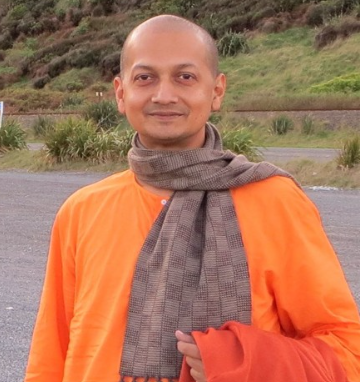
Swami Sarvapriyananda has spent much of his life explaining ancient Indian spiritual philosophy to modern audiences
Known for his clear lectures on Vedanta and consciousness, he has built an international following among people interested in spirituality, philosophy, psychology and the nature of the human mind.
However, his recent visit to the headquarters of artificial intelligence company Anthropic has brought him into a new kind of public conversation.
This raises important questions about how machines should behave, what values should guide their responses and whether advanced artificial intelligence could ever be conscious.
Swami Sarvapriyananda’s expertise in Advaita Vedanta offers a philosophical perspective on some of these issues.
His work explores the nature of the self, the meaning of consciousness and the relationship between individual experience and ultimate reality.
His visit does not mean that spiritual teachings have replaced scientific research.
Instead, it highlights why conversations between technology experts, philosophers and religious thinkers may be useful as society considers the consequences of increasingly powerful AI systems.
From his childhood in India to his role as the spiritual leader of the Vedanta Society of New York, his journey is an interesting story of faith, education and intellectual curiosity.
Also Read: Eagles Star Lane Johnson Bio: NFL Career and Achievements
Table of Contents
Who Is Swami Sarvapriyananda?
Thoughts arising in the mind like desires, etc. are the seen. One should meditate on Consciousness as their witness. This is the meditation with duality associated with the seen. [Verse 24]#DrikDrishyaViveka
— Priyananda Doss (@sarvapriyananda) November 14, 2020
Early Childhood and Family Background
Swami Sarvapriyananda’s early life played an important role in shaping his spiritual interests. He grew up in Bhubaneswar, a city in the Indian state of Odisha, in a family that had a close connection with the Ramakrishna Order.
According to published accounts of his life, his parents and grandparents were initiated devotees in the Ramakrishna tradition. Religious practice was therefore a familiar part of his childhood.
He saw his parents meditate and accompanied them on visits to the ashram. The teachings and lives of Sri Ramakrishna and Swami Vivekananda also influenced him from an early age.
However, his childhood ambitions were not limited to religion. He once dreamed of becoming a pilot.
His early goals reportedly included both flying an aircraft and finding God. As he grew older and explored spiritual literature more deeply, the search for God gradually became more important to him.
This change did not happen overnight. It developed through years of reflection, study and exposure to spiritual teachings.
Eventually, he decided that a monastic life would allow him to devote himself more fully to understanding and sharing those teachings.
His decision was significant because it meant choosing a path very different from the conventional career that his education might have prepared him for.
His family initially had reservations about his decision to become a monk but they later accepted his choice and supported him.
His story is a reminder that a person’s professional direction can change considerably as their interests and priorities develop.
In Sarvapriyananda’s case, an early fascination with aviation gave way to a lifelong search for spiritual understanding.
Quick Bio
| Detail | Information |
|---|---|
| Name | Swami Sarvapriyananda |
| Birth name | Biswarup Mitra |
| Profession | Hindu monk, spiritual teacher and Vedanta scholar |
| Religious tradition | Ramakrishna Order |
| Main philosophical focus | Advaita Vedanta |
| Place of upbringing | Bhubaneswar, Odisha, India |
| Educational institution | Xavier Institute of Management, Bhubaneswar |
| Joined Ramakrishna Math and Mission | 1994 |
| Received final monastic vows | 2004 |
| Current leadership role | Minister and spiritual leader of the Vedanta Society of New York |
| Assumed New York leadership | January 2017 |
| Academic fellowship | Nagral Fellow at Harvard Divinity School, 2019–2020 |
| Known for | Lectures on Vedanta, consciousness and philosophy |
| Recent public interest | Visit to Anthropic’s headquarters in San Francisco |
| Nationality | Indian |
Swami Sarvapriyananda’s Decision to Become a Monk
Before entering monastic life, Swami Sarvapriyananda pursued higher education in business management at the Xavier Institute of Management in Bhubaneswar.2
His academic background is an interesting part of his biography. He did not begin his adult life by immediately entering a monastery. Instead, he completed his formal education before deciding to devote himself to spiritual work.
Published biographical accounts state that he joined the Ramakrishna Math and Mission in 1994, when he was around 23 years old. He later received sannyasa or final monastic vows, in 2004 from Swami Ranganathananda.
In Hindu traditions, taking sannyasa generally means making a serious commitment to a life focused on spiritual realization, discipline and service. For Sarvapriyananda, this commitment became the foundation of his later work as a teacher.
His education in business management did not become the central subject of his public career. Instead, he used his intellectual abilities to study and communicate philosophical ideas.
His later lectures demonstrate an interest in careful reasoning, clear explanations and the relationship between traditional teachings and contemporary questions.
Career Within the Ramakrishna Order
Swami Sarvapriyananda’s work within the Ramakrishna Order has included teaching, educational administration and spiritual leadership.
After his monastic formation, he served as a teacher at the monastic probationers’ training centre at Belur Math in West Bengal.
Belur Math is the headquarters of the Ramakrishna Math and Mission and an important centre in the organisation’s spiritual and educational activities.
He also held positions at educational institutions connected with the organisation. These included serving as vice principal of Deoghar Vidyapith, principal of Shikshanamandira teacher-education college and the first registrar of Vivekananda University, according to published biographical reporting.
These roles gave him experience in education and institutional service before his work became more internationally visible.
In 2015, he began serving as assistant minister at the Vedanta Society of Southern California in the United States. He subsequently became the minister and spiritual leader of the Vedanta Society of New York in January 2017.
The New York position placed him in a setting where Indian spiritual traditions could be discussed with audiences from different cultural and religious backgrounds. His responsibilities included teaching Vedanta, leading spiritual programmes and helping people understand classical Indian philosophy.
His career shows that monastic life can involve more than private meditation. It can also include teaching, public communication, education and dialogue with people outside one’s own religious tradition.
What Is Advaita Vedanta?
To understand why an AI company might invite Swami Sarvapriyananda, it helps to understand the philosophical tradition he teaches.
Advaita Vedanta is a school of Hindu philosophy associated with the idea of non-duality. The Sanskrit word advaita means “not two.”
The tradition explores the relationship between the individual self, known as Atman and ultimate reality, known as Brahman. In its classical formulation, Advaita Vedanta argues that the deepest reality of the self is not separate from Brahman.
It also examines how people come to identify themselves with their bodies, thoughts, emotions and changing experiences. These teachings are developed through philosophical texts such as the Upanishads and the writings of influential Vedanta teachers, including Adi Shankaracharya.
Swami Sarvapriyananda explains these ideas through lectures and discussions that connect traditional texts with questions familiar to modern audiences.
For example, consider a simple question: when a person says, “I am thinking,” what exactly is the “I” in that sentence? Is it the body, the thoughts, the personality or the awareness through which these experiences are known?
Advaita Vedanta approaches such questions through philosophical inquiry and contemplative practice. It encourages people to examine their assumptions about identity and experience rather than accepting every assumption without reflection.
This makes the tradition relevant to contemporary philosophical discussions about consciousness. It does not mean that Vedanta and neuroscience are the same field or that spiritual claims automatically qualify as scientific findings.
Rather, they approach certain questions from different perspectives. That distinction is particularly important when discussing artificial intelligence.
Also Read: Joe Flacco Bio: What Happened to the NFL Quarterback?
Why Did Anthropic Invite Swami Sarvapriyananda?
There are several reasons this type of conversation may be useful.
1. AI systems raise questions about right and wrong
AI systems increasingly assist people with writing, research, coding, education and decision-making. Their responses can influence how users understand information and approach difficult problems.
Developers therefore need to consider more than whether a model can produce a convincing answer. They must also consider whether its behaviour is reliable, responsible and appropriate.
Religious and philosophical traditions have explored questions of duty, responsibility, harm, honesty and human welfare for centuries. Their perspectives can contribute to discussions about what people expect from powerful technologies.
However, philosophical advice is only one input. It does not replace technical testing, safety evaluations or evidence-based policy decisions.
2. Intelligence and consciousness are different questions
One of the most important distinctions in this discussion is the difference between intelligence and consciousness.
An AI model may generate sophisticated language, solve problems or respond to complicated questions. These abilities do not, by themselves, establish that the model has subjective experiences.
Consciousness concerns questions such as whether there is something it feels like to be a particular being and how subjective experience arises. Philosophers, neuroscientists and cognitive scientists continue to debate these issues.
Advaita Vedanta has its own detailed account of awareness and the self. Sarvapriyananda’s knowledge of this tradition makes him a potentially valuable participant in conversations about how different intellectual traditions understand consciousness.
His involvement does not prove that AI is conscious or that it cannot become conscious. It creates an opportunity to examine the question from more than one perspective.
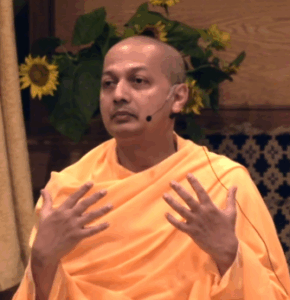
3. Religious traditions can contribute to ethical discussions
Technology companies operate in societies where people hold different moral, cultural and religious beliefs. Their AI systems may be used by people whose values and circumstances differ considerably.
Listening to thinkers from multiple traditions can help developers identify assumptions they might otherwise overlook.
Swami Sarvapriyananda’s background in Vedanta provides one perspective on identity, suffering, self-understanding and moral responsibility. Other religious and philosophical traditions offer their own approaches.
The goal need not be to adopt a single religious worldview. Instead, dialogue can help people understand how different traditions approach difficult questions and where their ideas may agree or disagree.
4. The future of AI is a human question too
AI development is often discussed in terms of computing power, new capabilities and competition between companies. Yet the effects of these systems ultimately extend into human life.
People must decide how AI should be used, what risks are acceptable and how its benefits should be shared. These are not exclusively engineering questions.
Philosophy, ethics and spiritual traditions can help frame discussions about what society values and what responsibilities accompany technological power.
This broader perspective helps explain why a Vedanta monk could be invited to a technology company’s headquarters. His role is not to replace engineers but to contribute a different kind of expertise.
Swami Sarvapriyananda’s Work at Harvard and Beyond
His visit to Anthropic did not emerge in isolation. Swami Sarvapriyananda had already spent years engaging with academics and philosophers interested in the mind, consciousness and the nature of reality.
During 2019–2020, he served as a Nagral Fellow at Harvard Divinity School. The fellowship supported his engagement with Hindu traditions and spiritual leadership in an academic environment.
His wider work has included public lectures, interfaith programmes and conversations with thinkers from different intellectual backgrounds. He has also participated in dialogues with philosophers such as David Chalmers and has spoken at public events that bring together spirituality, philosophy and science.
This background helps explain why his perspective could interest researchers working on advanced AI. His work is not limited to explaining religious rituals or traditional beliefs.
It also addresses philosophical questions that remain difficult to resolve, including the nature of awareness and the relationship between subjective experience and the world. His approach has helped make classical Indian philosophy accessible to audiences who may have little previous knowledge of Hindu spiritual traditions.
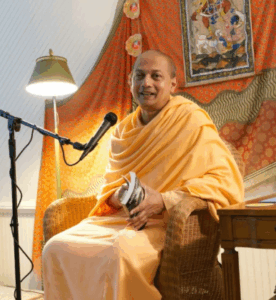
Why Is Swami Sarvapriyananda Trending in 2026?
Swami Sarvapriyananda has gained renewed attention because his visit to Anthropic connects an established spiritual tradition with one of the most prominent technological debates of the moment.
Reports published in early October 2026 brought his account of the visit to a wider audience.
His discussions with the AI company have raised questions about why technology developers might consult religious thinkers and what ancient philosophy can contribute to conversations about AI behaviour and consciousness.
There are three main reasons for the growing interest.
First, the meeting is unusual. A Vedanta monk visiting an AI research company is not an everyday occurrence, so the story naturally attracts curiosity.
Second, the subject is relevant to a broad audience. People are increasingly encountering AI in their personal and professional lives.
Questions about how these systems should behave and whether they could ever become conscious are no longer limited to academic circles.
Third, Sarvapriyananda’s background gives the story a deeper philosophical dimension.
His teachings encourage people to examine assumptions about identity and awareness, making his perspective relevant to discussions about the meaning of consciousness.
His growing visibility therefore reflects more than a newsworthy meeting. It demonstrates the increasing importance of conversations that cross the boundaries between technology, philosophy and spirituality.
What Can Vedanta Teach Us About Artificial Intelligence?
It is important to be careful when connecting ancient philosophy with modern technology.
Advaita Vedanta developed within a specific religious and philosophical tradition, while artificial intelligence is built and studied through computer science, mathematics, engineering and related disciplines.
The two should not be treated as interchangeable. Nevertheless, their intersection can encourage useful questions.
For example, does producing intelligent language necessarily mean that a system understands what it says?
What evidence would be needed to establish that an artificial system has subjective experience? How should developers respond when the scientific and philosophical answers remain uncertain?
These questions require careful investigation. A convincing conversation with an AI system is not sufficient evidence of consciousness, just as philosophical reflection alone cannot settle every technical question.
Vedanta can contribute concepts and arguments for examining awareness and identity. Scientific research can investigate the mechanisms and behaviour of artificial systems. Ethics can help establish principles for how these systems should be developed and used.
Bringing these approaches together does not guarantee agreement. In fact, differences between them may be especially valuable because they reveal assumptions that need closer examination.
Swami Sarvapriyananda’s visit to Anthropic is an example of how such conversations can begin.
The public information available does not establish precisely how the discussions affected the company’s models but the meeting has drawn attention to a wider question: how can society think responsibly about technologies whose capabilities are changing rapidly?
View this post on Instagram
FAQ’s
1. Who is Swami Sarvapriyananda?
Swami Sarvapriyananda is an Indian Hindu monk belonging to the Ramakrishna Order. He is the minister and spiritual leader of the Vedanta Society of New York and is widely known for his lectures on Advaita Vedanta, consciousness and Indian philosophy.
2. Why did Anthropic invite Swami Sarvapriyananda?
Anthropic invited him to its San Francisco headquarters for discussions involving artificial intelligence, ethics, morality and consciousness.
His expertise in Advaita Vedanta offers a philosophical perspective on questions about the self and awareness. Many details of the meeting remain private because he signed a non-disclosure agreement.
3. What is Swami Sarvapriyananda’s real name?
His birth name is Biswarup Mitra. He adopted the monastic name Swami Sarvapriyananda after entering the Ramakrishna Order’s monastic tradition.
4. Where was Swami Sarvapriyananda born and raised?
Published biographical accounts identify Kolkata as his birthplace and Bhubaneswar in Odisha as the place where he grew up.
5. What is Advaita Vedanta?
Advaita Vedanta is a school of Hindu philosophy centred on non-duality. It explores the relationship between the individual self and ultimate reality, as well as the nature of consciousness and human identity.
Conclusion
Swami Sarvapriyananda’s journey from a spiritually inclined childhood in India to becoming a respected Vedanta teacher in New York reflects a lifelong commitment to understanding the nature of the self and consciousness.
These questions remain open to debate. Swami Sarvapriyananda’s contribution is not a definitive technical answer but a philosophical perspective grounded in a long tradition of inquiry.
Ultimately, the meeting highlights why conversations between technology experts, philosophers and spiritual teachers may matter as artificial intelligence advances.
It also shows that ancient Indian philosophy can participate in contemporary debates without replacing the scientific research needed to understand and develop AI responsibly.
Also Read: John Clarke Biography: Know More About The Nobelist